
The 1932 Winter Olympics
Held in Lake Placid, but Could Have Been Yosemite

Two days until the 2026 Winter Olympics opening ceremony in Milan. Time for a quick look back at the 1932 Winter Games.
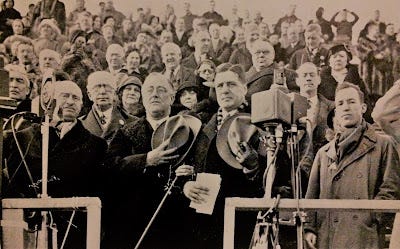
February 4, 1932: The 1932 Lake Placid Olympics—the 3rd winter edition (that’s if you don’t count the figure skating and ice hockey events held as part of the 1908 and 1920 Summer Olympics)—are best known for Dartmouth’s Jack Shea ascending the first Olympic podium after his speedskating win on his home track; New York Governor Franklin D. Roosevelt opening the games in front of British figure skater Mollie Philips who became the first female flag bearer (behind her 11-year-old Cecilia Colledge became the youngest ever Winter Olympian); and Eddie Egan becoming the first (and to this day only) Olympian to win a gold medal in both the summer (boxing 1920) and winter (four-man bobsled 1932) Olympics in front of 14,000 (!) spectators lining the mile-and-a-half “bob-run.”
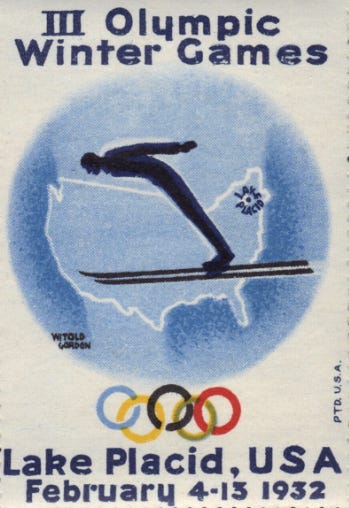
Unlike the record-breaking Los Angeles Olympics held later that year, the 1932 Winter Olympics were a modest affair comprising just four sports: ice hockey, bobsled, speed and figure skating, and Nordic skiing—cross-country, ski jumping and combined. Conspicuously absent were any alpine skiing events which first appeared in 1936, only after the International Ski Federation (FIS) came to an understanding with the IOC about “broken time payments”, much like FIFA had.
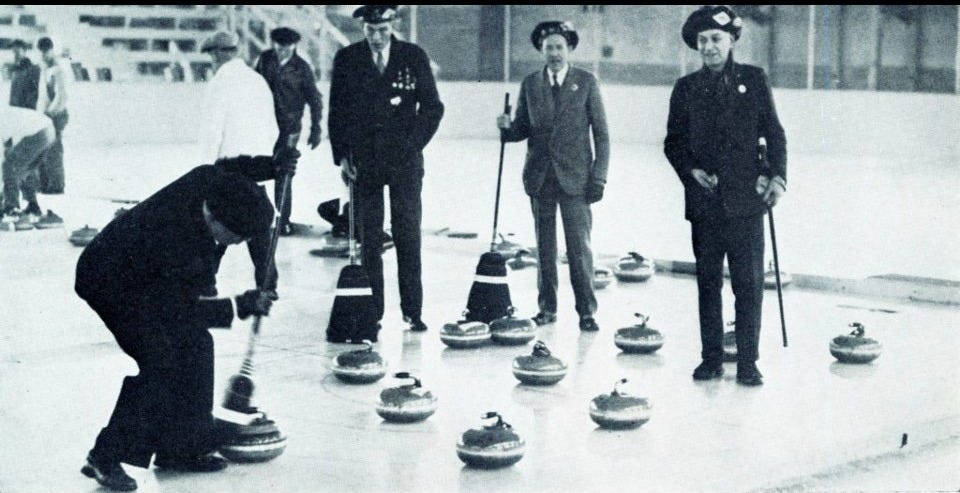
Demonstration sports included women’s speedskating, sled-dog racing and my favorite, Scottish-born curling. Nearly half of the 250 athletes hailed from the US and Canada, and only 10 of the 17 participating nations went home with any hardware. An independent, self-governing Dominion of Newfoundland was one of 65 National Olympic Committees invited, but did not attend. Fifty-three state troopers handled “security” (parking enforcement and traffic in reality) and the only ice in town was on the skating surfaces.
In the Red
Where the 1932 Los Angeles Games would realize a million dollar surplus, Lake Placid struggled to cover expenses. Although the New York State Legislature ultimately appropriated grants totaling $500,000 toward construction of America’s first bobsled run on Mt. Van Hoevenberg ($243,000) and an Olympic stadium ($155,000); Essex County, the Lake Placid Club and private donations—primarily from New York City— bridged some of the gap; the town of North Elba—home to just 4,000 people and the village of Lake Placid—ate a good chunk of the infrastructure costs.
Most notable was the nearly $300,000 spent on an indoor rink—the first in Winter Olympic history—where figure skating, curling and half the hockey games were held. Like Milano Cortina 2026, when the hockey rink was still unfinished less than a month before the Games, construction of the Lake Placid arena finished less than three weeks before the first puck dropped. Canada would take home the gold with five wins, a tie and no defeats in what is now named the Jack Shea Arena.
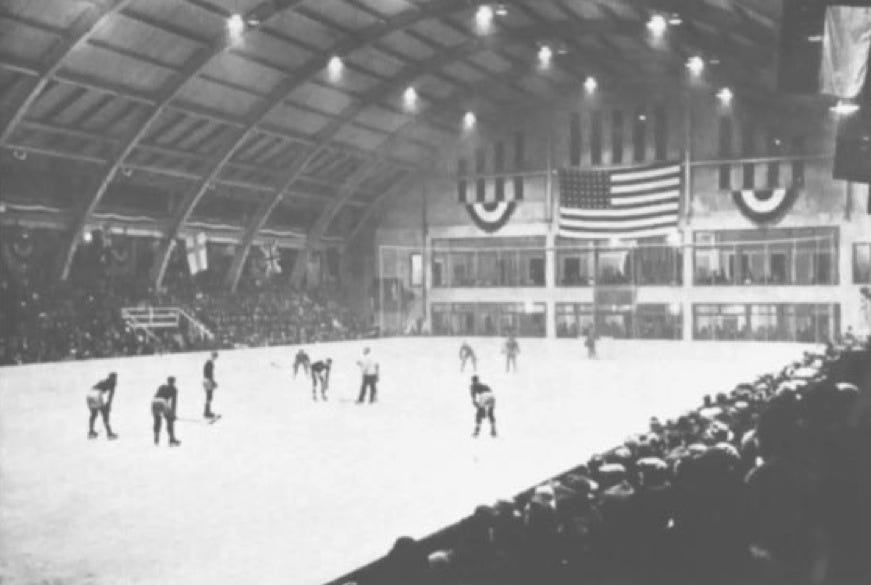
Gate receipts for the entire ten-day Olympics totaled just $93,000 on 58,000 paid admissions (only marginally more than the committee’s publicity budget)—and locals were left to carry the burden. The IOC President’s comments were cold comfort when he thanked local residents, calling their contribution “a greater burden than any other community of its size” had ever assumed in staging an Olympic contest. With two bond issues totaling $350,000—widely supported by local voters—in 1929 and 1931, the per capita indebtedness in the small town—even after the state covered part of the deficit—came to $58.75 ($1,350 today). The popular and profitable Los Angeles Olympic spectacle of 1932—and the $1.5m in ticket sales—this was not.
Yosemite’s Failed Bid
In 1926, the IOC stated its preference for awarding the Winter Olympics to the same country that would host that year’s Summer Games. Californians argued that it ought to be the same state, but the committee thought otherwise. Three years later, the IOC unanimously selected Lake Placid’s bid, led by Dr. Godfrey Dewey, son of Melville, of Dewey Decimal System fame and antisemitic/racist/sexist infamy (under his family’s leadership the Lake Placid Club had a long history of excluding Jewish members).
The Adirondack site had been chosen because of its infrastructure—what organizers called “the winter-sports capital of America”, its “ideally suited” winter climate and terrain, and the local club’s generation-old “international reputation” as host of championship events, not to mention the shorter travel time—compared to California—for the Europeans set to attend. But an unseasonably warm January followed by unsettled weather during the Games presented a real challenge (the state weather bureau called it “the most unusual weather in 147 years of record-keeping”); all the infrastructure wasn’t in place; nor were their sufficient accommodations available—reduced to $2-4 per day—in the small town, as evidenced by the many athletes and visitors who stayed in 500 area homes and newly “winterized” summer cottages.
William F. Humphrey, longtime president of San Francisco’s Olympic Club, a member of the California Olympiad Commission as well as the Los Angeles Olympic Organizing Committee expressed “outrage” after Lake Placid’s selection and promised to stage his own northern California “winter games” if the IOC didn’t reconsider. They didn’t, and he did.
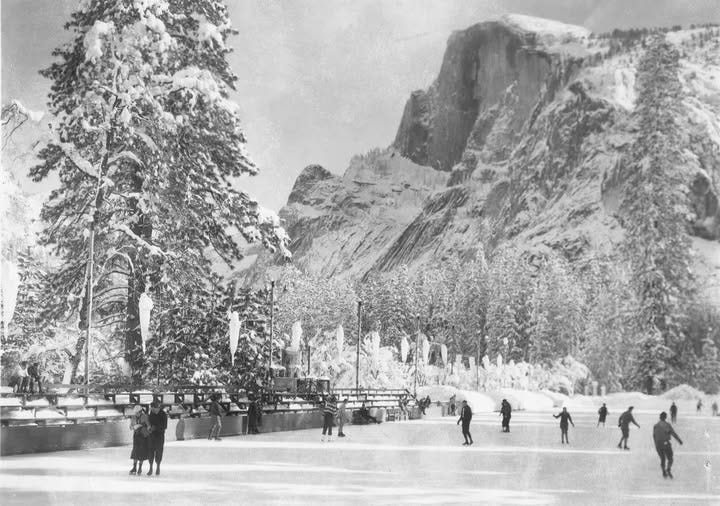
Seven US cities had pitched the IOC on their candidacy including Tahoe City and its optimistically-named “Olympic Hill”, but the real California front-runner was always Yosemite Valley. After visiting St. Moritz for the 1928 Winter Olympics, Donald Tresidder—Yosemite royalty with his marriage to Marry Curry of the Curry Village founders—was inspired to make Yosemite the “Switzerland of the West.” The future Stanford University president oversaw the construction of new roads and the Ahwahnee Hotel in 1927, but his dream of bringing the Olympics to the national park never materialized.
Despite promises of infrastructure investment to the tune of $350,000 ($8m today) and support for the valley’s candidacy from heavy hitters of the Yosemite Winter Club including William May Garland (LA Olympic Committee President & IOC member), Harry Chandler (LA Times publisher) and even filmmaker Cecil B. DeMille, Yosemite lacked the wintry reputation to carry the day. Another generation would pass before northern California finally had the opportunity to host the Winter Games (Squaw Valley 1960). Lake Placid, of course, had its second turn at hosting in 1980 when the “Miracle on Ice” made Olympic hockey history.
Film of several events from Lake Placid in 1932 for those so inclined:
Adirondacks are magical. Really enjoyed this post. Went to the village (in the summertime) in 1999, and it still retained a bit of that international flavor. It should host again!
This is a great piece. The contrast between Lake Placid’s civic sacrifice and LA’s financial success in fascinating—and it’s striking how many of the same themes (unfinished venues, local burden, weather risk) echo forward to modern Games. History may not always repeat, but it definitely rhymes.