
Tickets, please
Registration for LA28's first ticket draw opens this week. How different it was in 1932.

Olympic tickets for 50 cents? Can I interest you in an all-access Coliseum pass for $22? Too good to be true, you say? Not in 1932.
LA28’s ticket draw registration begins on January 14, 30 months before the Games officially open. With the backlash from FIFA’s “dynamic pricing” and eye-watering prices for this summer’s World Cup, LA28 appears to be taking a more fan-friendly approach, highlighting the buzzword of the moment— “affordability.” At least one million tickets including every sport will go on sale for, fittingly, as low as $28 (but rising into the thousands) and locals (five southern California counties and Oklahoma City—hello softball) will be granted a special early access window in April.
Projecting $2 billion in ticket sales, LA28 is aiming to match London 2012’s record-setting 97% of available seats sold. This will include some 14 million seats across 51 sports, but the opening and closing ceremonies, basketball, track & field, gymnastics and soccer will likely represent 70% of the total. As in 1984, organizers are projecting a budget surplus.
In 1932, no one knew what to expect. But at least one man from Maine had high hopes.
From “Garland’s Folly” to Record Ticket Sales
As President of the 1932 Los Angeles Olympic Organizing Committee, William May Garland had many tasks over the nine years between winning bid and opening ceremony. In 1930, his duties included sending official invitations to the more than 50 National Olympic Committees then in existence. But the Depression (unemployment stood at 24%) combined with the unprecedented travel requirements left many delegations non-committal. By February 1932, when the Lake Placid Winter Olympics kicked off, no one had officially confirmed their intent to attend.
Though the first ticket applications arrived a year before the Games, three months before the opening ceremony just 15,000 tickets had been sold via (mostly) out-of-state mail-in and walk-up orders. This, despite 400,000 ticket brochures circulating among university alum, clubs and the general public. Cynics called the whole endeavor “Garland’s Folly” as spring became summer.
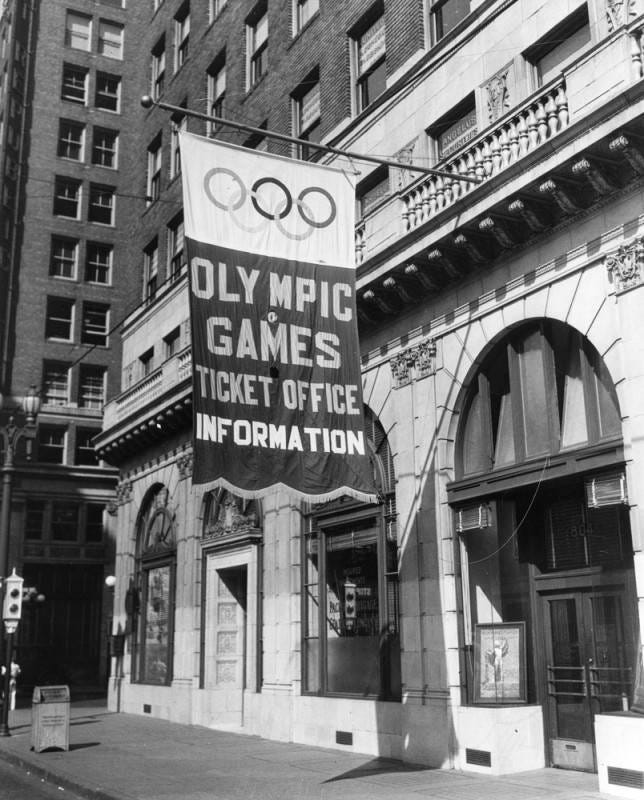
When the ticket office opened in April, disappointing sales forced most of the 60 “sales girls” to work part-time. By July 1st, just a month before the opening ceremony, fewer than 250,000 tickets ($265k) had been sold. Stories in the Los Angeles Times and other city newspapers of “high ticket demand” and tickets “selling fast” were more promotion than accurate reporting. Further complicating the issue, on June 20 the US Congress had enacted a Revenue Bill which imposed a 10% tax on all amusement tickets. Rather than deal with the confusion and potential fall-out, the committee, calling it a “matter of considerable concern”, elected to absorb the tax in its the original pricing (ultimately costing $111,704 in lost income).
Despite the challenging environment, Garland, at least publicly, remained bullish and asked the ticketing manager, Jack Mackenzie, to print two million tickets (2.9 million were printed in the final tally). But privately, Garland admitted real trepidation. He later shared that he had suffered nightmares of Vice President Curtis opening the Games in front of 10,000 children and the organizing committee’s creditors.
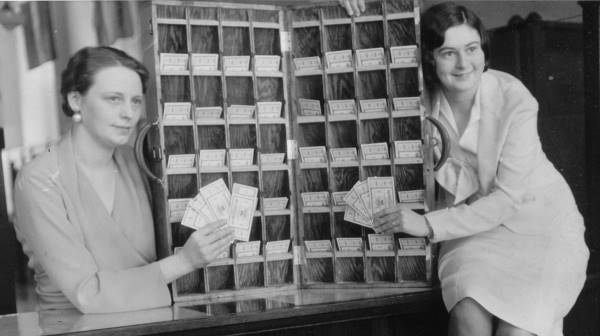
He needn’t have lost any sleep. As the world’s athletes began to fill the Olympic Village and the Games drew near, ticket sales surged dramatically with nearly $300k worth sold the week leading up to the Games—just as Garland had predicted. Twenty additional sales clerks were added to handle demand, hours were extended and the ticketing manager claimed it was “the heaviest ticket-selling job ever undertaken in this country.”
As the opening ceremony dawned, more than $750k worth of tickets had been sold—twice the total for the entire Amsterdam Games four years earlier—and the Games had not even begun. Buyers grabbed the last few tickets for the opening ceremony just three hours before the spectacle commenced. Those looking to buy at the Coliseum met with disappointment—there would be no on-site sales. All told, more than 70% of all ticket revenue changed hands over the 90-foot-long counter at the downtown central office.
Given the dire economy, the committee kept average prices low at just over $1. Prices ranged from 50 cents ($12 today) for single sessions and children’s tickets to $3 ($72 today) for the opening ceremony, American football exhibition, and the final day of rowing. Action at the Long Beach Marine Stadium ranked second in spectator popularity ahead of swimming and behind only track and field, which, with 43,000 average daily spectators, accounted for more than a third of all ticket revenue.
The Los Angeles Times described the downtown ticket office as a “mob scene” on Wednesday, August 3. At $86k in sales, it would prove to be the daily high-water mark—and most wanted to get their hands on the orange track & field tickets granting entry into the Coliseum. After their photo finish in the men’s 100-meter final, interest in the black American sprinters Eddie Tolan and Ralph Metcalfe reached a fever pitch. More than 85,000—nearly double the previous high attendance of prior Games—filled the Coliseum for their much-anticipated rematch in the 200-meter finals.
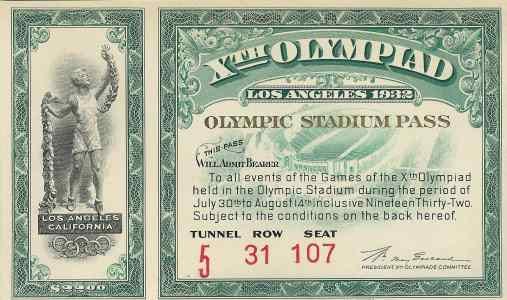
Others gained access via the Olympic Stadium Pass, which included admission to all scheduled events in the Coliseum (the opening and closing ceremonies, track & field, gymnastics, field hockey, American football & lacrosse, the final two days of equestrian events and all medal ceremonies). It proved popular (10k adults and 2k children caught all the action), despite costing $22 ($525 today). It was transferrable, but re-sale was prohibited with scalpers so warned.
“Season passes”, granting access to all events in a given sport also found favor, none more so than swimming. Helms Bakery, official Olympic bread supplier and master marketers, understood this and ran a ticket contest that asked for letters describing why they liked Helms Olympic bread in exchange for a chance to win a “season pass”.
The marathon, race walk, modern pentathlon, yachting, and road cycling would be free to watch, providing all Angelenos an opportunity to witness the action.
LA Knows How to Put on a Show
In the final accounting, the 1932 Los Angeles Olympics boasted record average daily attendance of 78,000 across all venues—all the more remarkable without soccer on the program which outdrew all other sports combined in the 1928 Amsterdam Olympics. More than 1.1 million tickets had been sold—nearly twice the total of the two previous Games—at an average price of $1.28 ($30 today), totaling nearly $1.5m in revenue ($36m today). Another 89,000 enjoyed free admission. Children represented some 139,000 of these attendees. I cannot help but wonder—are any still out there today?
The 1984 Los Angeles Games are widely considered the most financially successful—and innovative—Olympics to date. Given the context in which the 1932 Games were held, the profit turned may be just as remarkable. Who would bet against another blockbuster of a Games in 2028?
Having covered the 2012 games for CNN I am amazed to read that it sold 97% of all tickets. I bought some myself but there was no much negative (and unwarranted) press beforehand.
Excellent piece - fascinating look at the birth of sports as entertainment.