
The "Enhanced Games"
aka the "Doped Olympics"

A centimeter made all the difference. Well, that, and a positive drug sample eight years later.
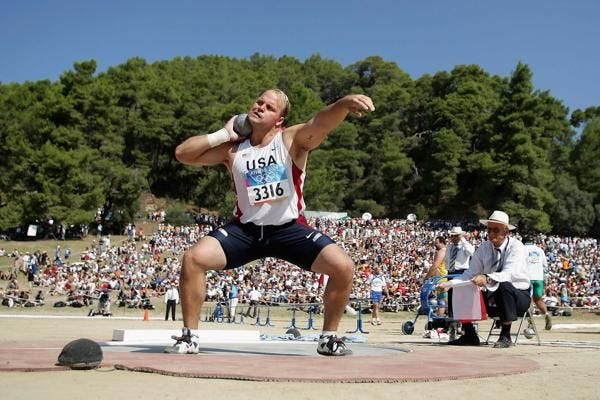
When I visited ancient Olympia, I raced my daughters over a stadia, listened to my wife explain the Greek gods and goddesses, and marveled at the millennia-old artifacts. And it was there, in the last display case of the exhibit hall, that I saw my one-time Dartmouth College teammate, Adam Nelson, featured.
The 2004 Athens Olympic shot put was held in Olympia—and it was filled with high drama. Adam’s first throw (21.16m) led the field—by one centimeter— through the sixth and final round, when Ukraine’s Yuriy Bilonoh, in the last possible moment, equaled the mark. Tie-breakers were determined on the thrower’s second best mark, and since Adam had fouled on all of his other tries, he had one last opportunity to re-claim the gold. Unfortunately, he fouled again and had to settle for a silver medal in a repeat of his Sydney Olympic performance. Except that he didn’t.
A biological sample stored by the world doping agency and re-tested more than eight years after the competition revealed a positive test for the Ukrainian. Adam had his podium moment in 2004, but it was not the top step that he deserved. Adam, and many Olympians after him, have now been awarded their medals long after their competitions. From the 2012 London Olympics alone, some 50! medals have been reallocated, many of them from doped Russian athletes. It’s become such a common occurrence that the IOC has a whole policy on the process, including various ways the athlete can choose to be honored. Adam’s experience in an Atlanta airport food court was quite different, as he discussed in this short clip. Drug cheats—and catching them—have, unfortunately, become a common part of the Games.
Enhanced Games
Which brings me to the Enhanced Games, set for this coming Sunday May 24 in a custom-built venue in, where else, Las Vegas. The Games will feature 50 sprinters, swimmers and weightlifters competing in the most elemental of sports. Oh, and they’ll be doped to the gills. The whole thing reminds me of the 2017 award-winning documentary Icarus that helped expose the Russian state-sponsored program that has left the country’s athletes competing under the somewhat ridiculous AIN neutral flag, Athlètes Individuels Neutres. To the dismay of many, Russia is on the cusp of being welcomed back into the Olympic family.
Doping questions taint so many extraordinary performances. When Sebastian Sawe recently broke the once-unheard-of two-hour barrier in the men’s marathon, doubters immediately questioned if he was clean, despite all the out-of-competition drug testing he and his shoe sponsor, Adidas, had voluntarily subjected him to. Fair enough, given that the first woman under 2:10 was later found to be doping—yet her record stays on the books. Drug suspensions are a regular topic of discussion from Letsrun message boards to InsidetheGames’ “the week in doping” column. Cyclists have added carbon monoxide doping to their repertoire and British climbers summiting Everest have used xenon gas to short circuit the need for acclimatization. How did it come to this?
Doping History
In the 1932 Los Angeles Olympics there were no doping allegations unless one counts the bootleg liquor in Prohibition America, or the bitter swim coach pointing a finger at the Japanese for inhaling oxygen before and after their races. The IAAF, track & field’s governing body, became the first sporting federation to address doping in its 1928 Handbook stating: “Doping is the use of any stimulant not normally employed to increase the power of action in athletic competition above the average.” The IOC had yet to weigh in.
Athletes had used stimulants to improve performance since the modern Olympics began. Caffeine, chocolate, and tobacco were the most common, though the ill-informed also used alcohol and strychnine in their quest to gain a competitive edge. Other performance-enhancing techniques gained favor as well. Some athletes swore by ultraviolet light irradiation in the belief that it had invigorating properties.
Springfield, Massachusetts’s Howard Drew, the first to be dubbed “world’s fastest human”, seemed a good bet to win the 100-meters in the 1912 Games after winning the Olympic Trials at Harvard. But after sitting in a cold Stockholm stadium spectating all day, he pulled his left hamstring at the end of his Olympic semi-final. His trainers tried everything to make him fit for the final—they numbed and baked his leg in saltwater, and, drum roll, considered giving him cocaine—to no avail.

Before the Modern Olympics even began, questionable “science” made the rounds. In 1889, French physician, Charles-Édouard Brown-Séquard, injected himself with fluid from the testes of dogs and guinea pigs. He announced his findings at a scientific meeting in Paris, claiming to feel years younger, and died within a few years.
The gland grafting craze of the 1920s was perhaps the strangest episode—and may have entered the world of athletics. Thousands of mostly wealthy men had thin slices of chimpanzee or baboon testicles inserted into their own in the belief that it slowed ageing, improved sex drive and boosted memory. It didn’t, but the placebo effect was often strong. Hundreds of surgeons applauded the Russian-born doctor, Serge Voronoff, for his efforts but the fad thankfully ended. It did, however, lead to a new cocktail.

All of this may have been bunk for performance enhancement, but the 1935 isolation and synthesis of the predominant male sex hormone, testosterone, was not. For his work, the Nazi chemist, Adolf Butenandt won a Nobel Prize in Chemistry in 1939. During the Holocaust and World War II, the Germans reportedly tested anabolic steroids on prisoners, the Gestapo and Hitler himself.
Steroids soon found their way into athletics, first with Soviet weightlifters, and then to other athletes in America and beyond. Pennsylvania’s York Barbell club was among the worst offender. As David Maraniss wrote in his Sports Illustrated 2008 Book of the Year, Rome 1960, amphetamines (“pep pills”) were the biggest doping issue of the day. But the anabolic steroid, Dianabol, also sprung on the Olympic scene as a means to build muscle mass and boost strength.
The Ukrainian who initially won the 2004 Olympic shot put didn’t use Dianabol. His drug of choice was oxandrolone, used to promote weight gain after severe trauma, chronic infections, or surgery. Undetected at the time, testing finally caught up to him. Last week, Patrick Arnold, the infamous chemist who created the hard-to-detect steroid, tetrahydrogestrinone, known as “the clear” and used by athletes from Marion Jones to Barry Bonds, died from unknown causes.
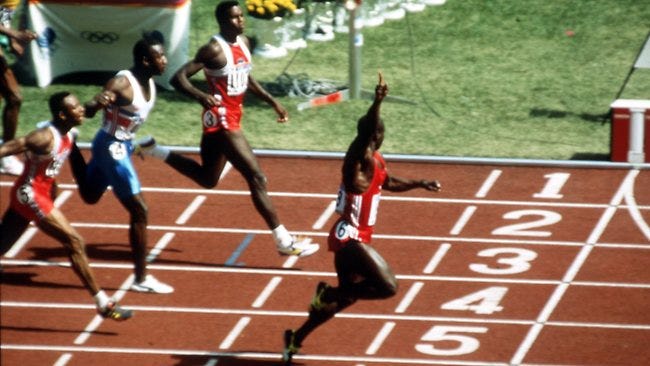
One can only imagine what will be coursing through the veins of those competing at the Enhanced Games. It might look something like this, but I doubt it.
Great article, Josh. And I love that your former teammate finally got his gold!
Timely stuff.. I hope the IOC is on the ball, and maintains zero tolerance for doping